- A Walnut Windsor Chair – Introduction
- The Log
- Transport
- Rough Lumber
- Seat Blanks
- Legs
- Arm Posts and Tapered Holes
- Carve the Seat
- Turn the Undercarriage
- Assembling the Seat and Undercarriage
- Spindles
- Arms
- Assembling the Spindles and Arms
- Crest Version 1 — The Form Bent Laminated Crest
- Crest Version 2 — The Steam Bent Crest
- Final Assembly
- Detailing
- Finishing a Walnut Windsor Chair
- Final Notes
Entry 6
Legs – 12/31/2007
These are the four legs, just off the lathe. The process of turning on the lathe has been referred to as “gerbiling” by my wife Ann. To see why, check out the bottom right picture on this page.
The next step after cutting out the seat blank is to turn a set of legs for the chair. Each blank is mounted in the lathe and turned and sanded to the shape shown in the top photo. This is a Philadelphia style leg. It is also the style Dunbar shows in his book on building a Windsor chair.
Starting with the square blank, I use a roughing gouge to turn it round. The rounded blank is then marked (pencil) with the points in the profile such as the beginning, high point and end of a curve. A parting tool is used at each point to establish the depth of the cut. The bulletin board at the top edge of the pictures has my full dimension drawings of the leg, stretchers, and arm post parts.
The leg is then turned using a spindle gouge, skewchi-gouge, and skew. The third photo in the sequence shows the partly turned leg. I do the vase part in the middle first, then the long taper of the lower leg and finally the top part including the taper that will fit into the seat.
After turning the leg, I sand it on the lathe. I use 120 grit sparingly to remove any chatter marks. Then, a thorough sanding with 150 grit, 240 grit and finally 320 or 400 grit. After sanding, the turning is polished. I grab a handful of shavings and hold them against the spinning leg. This burnishes the surface and makes any imperfections (sanding scratches) easy to spot.
Turning generates a fair amount of shavings. From turning two sets of four legs, I get the shopping bag full plus a bit more that you see in the bottom right photo. Before clean up, the area around the lathe is covered in these chips. Hence my wife’s reference to what I am doing as gerbiling.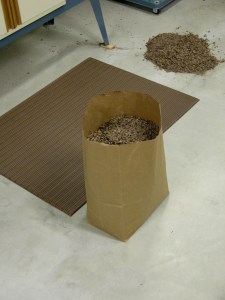
Walnut is a fun wood to work on the lathe. I keep my tools sharp and it turns easily. It also sands cleanly and takes a nice polish. I have also made chairs with legs of maple, birch, cherry, and pau ferro (Caesalpinia echinata, also called Bolivian Rosewood). All turn well, but walnut and maple are my favorites to work. All of these woods hold detail well and are not prone to chipping, which is essential to getting the nice, crisp detail in the leg.
The picture below shows the 3M face shield/powered respirator that I use while turning or shaping the seats (or anything else that is dusty). It provides good protection from fine dust and a face shield (I have prescription safety glasses on also). Some of the woods I use have toxins. Even those that do not are hazardous as a fine dust that can get into the lungs. Using a separate respirator and face shield can be cumbersome and the shield tends to fog. Notice that I also have hearing protectors. The hard hat is a bit of overkill, but it has protected my head from the low duct-work in my basement shop more than once.
(January, 2007)

 Spare Time